Chennai’s Broadway, a summer evening, 4 p.m. A family sets out to shop ten stores; bottles full. By the third shop, the water is gone and the heat is climbing.
Ten minutes later, discomfort has become urgency. One shop has no toilet — only a common one down the complex, stained, unusable. The next shop says no, too. Eleven shops and 300 metres later, the family is asking a bank for its toilet, past a security guard who doesn’t want to let them in. They leave in a hurry.
“The you in this story can be anybody, can be me. Yes, this is my story,” says Viswanathan Sridhar, founder of In.sane Labs.
So Viswa stopped thinking about sanitation as a product problem and started building a system.
Why Three, Not One
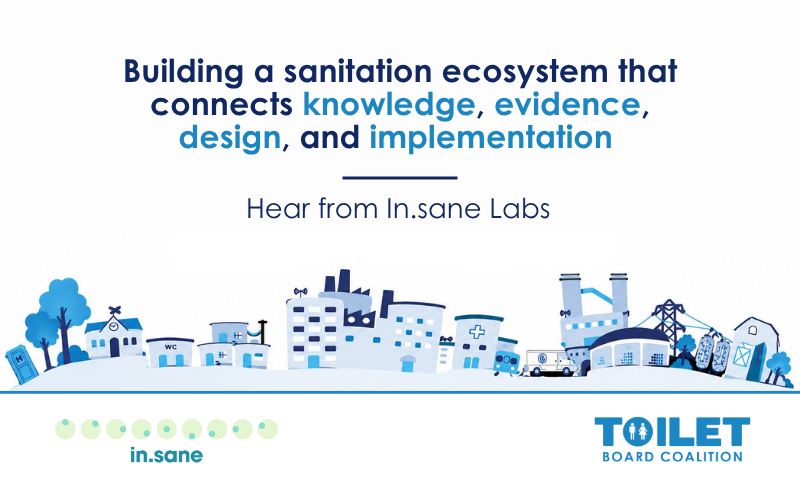
In.sane Labs is part of the Toilet Board Coalition’s Accelerator (2026 Cohort), building a sanitation system that goes beyond the toilet itself.
At its core are three interconnected verticals — Academia, Research and Practice — each developed in response to a gap Viswa kept encountering in the sanitation ecosystem.
Academia:
Developing sanitation-focused design curricula and modules to create pathways for students to engage with and specialise in sanitation design.
The first gap was upstream, in classrooms. Design students who wanted to specialise in sanitation had nowhere to do it; the discipline barely existed as a course of study. So, In.sane Labs built the curriculum itself: sanitation-focused design modules that give students a door in.
Research:
Developing publications and knowledge that seek to address gaps between academic thinking and industry practice.
The second gap sat between two kinds of paper: the kind academics publish, and the kind practitioners and planners actually use. Research on sanitation exists but translating that knowledge into real-world design and planning remains a challenge. In.sane Labs’ research and publishing work is intended to shorten that distance.
Its recently released comic is one example of how the studio is experimenting with taking sanitation knowledge beyond conventional research formats and into something a different audience can engage with.
Practice:
Translating knowledge, research and design thinking into interventions that respond to real-world sanitation challenges.
The third gap was the one Broadway put in front of Viswa personally: knowledge and research mean little if they never reach the person standing outside eleven closed shops looking for a usable toilet.
This is where In.sane Labs’ physical and planning interventions sit, from mobile public toilets and the sanitation marketplace to WASH master-planning.
The point isn’t simply that In.sane Labs has three verticals. It’s that they hand each other to work.
A classroom question can reveal a research gap. A research gap can become a design brief. What happens during implementation can feed back into what gets researched and taught next.
Instead of treating knowledge, design, and implementation as separate stages, the model is designed to keep them in conversation.
What the System Produces
1. Behaviour — In.sane Comics
Most sanitation communication is written for adults holding budgets, not children forming habits.
In.sane Comics uses story and character to reach children aged six to twelve, turning sanitation from a rule they are told to follow into a story they can understand and carry with them.
Comics also have real momentum in India right now. Industry researchers estimate India’s comic book market at around USD 687 million in 2024, growing roughly 12% a year, driven partly by renewed interest in homegrown Indian stories, not just imported ones. (Source: Grand View Research) Comic Con India, running since 2011 and now held annually across major cities including Chennai, draws over 200,000 visitors a year across its cities combined. (Source: Comic Con India, via Rolling Stone India) That tells us something simple: Indian audiences, including children, already want to read comics. In.sane Comics is built to meet that appetite with sanitation stories instead of leaving the space to superheroes alone.
Ambition goes beyond changing one child’s behaviour. It is about building sanitation awareness early enough for those behaviours and expectations to become collective over time.
2. Infrastructure — Mobile Public Toilets.
This is the intervention closest to Viswa’s own Broadway evening.
Hybrid-powered, pay-per-use units can be bicycle-mounted or heavy-vehicle-mounted and are supported by a Sanitation Intelligence Platform that gives users, operators and administrators different views of use and upkeep.
The principle behind them is straightforward: a fixed facility only serves someone who can reach it. Public sanitation also needs to respond to where people actually are.
But mobility alone does not solve the problem. The harder question is whether a facility remains usable, maintained, and trusted after it has been deployed. That shifts the conversation from simply installing infrastructure to sustaining it.
3. Systemic planning — WASH Master-Planning.
The third intervention moves further upstream: making sure WASH enters a masterplan at the beginning rather than appearing at the end as a compliance requirement.
This is where the case for the wider ecosystem becomes particularly clear. Academic thinking, research and lessons from implementation can feed directly into how large-scale planning decisions are made.
By the time sanitation is treated as an afterthought, many of the decisions that determine accessibility, usability and long-term maintenance may already have been made.
WASH master-planning attempts to move that conversation earlier — from fixing sanitation gaps later to designing them from the start.
Why the Ecosystem Approach Matters
A comic for a child. A mobile toilet on a crowded street. WASH embedded in a city masterplan. On the surface, they look like three very different interventions.
What connects them is the movement of knowledge between them.
A classroom can prompt a research question. A deployment can expose a design failure. A planning process can reveal what needs to be researched next. And lessons from each can travel back through the system rather than sitting in a report nobody reopens.
That thinking also aligns closely with the Toilet Board Coalition’s Sanitation Economy approach: sanitation understood as an interconnected economic and social system rather than a collection of isolated products and projects.
For In.sane Labs, being part of the Toilet Board Coalition Accelerator provides an opportunity to test that thinking alongside entrepreneurs, mentors and partners working at different points across the Sanitation Economy, and to explore where those different parts of the system can connect.
“What stood out to us about In.sane Labs is that they are not approaching sanitation through a single solution. They are looking at how knowledge, design, and implementation can inform each other, and how lessons from one part of the system can strengthen another. That systems thinking is very much at the heart of the Sanitation Economy, building solutions that are not only innovative on their own, but stronger because of how they connect.”
— Malavika Ravi, Accelerator & Investment Manager, Toilet Board Coalition
What Success Looks Like
Ask Viswa what success looks like, and he doesn’t reach for a metric. He reaches for a version of that same evening, years later, where it doesn’t happen to someone else. Where the eleventh shop has an In.sane unit outside it, tracked and maintained, not vandalised. Where the masterplan for that stretch of Broadway had WASH in its first draft, not its last. Where a child who grew up reading an In.sane comic is, by then, old enough to be the person who insists that sanitation belongs there in the first place.
“I want to see sanitation move from being treated as basic infrastructure to being understood as a fundamental part of how we design cities and care for people. Through In.sane Labs, I hope to build an ecosystem where architects, governments, communities, businesses and young practitioners can come together to rethink sanitation, in terms of toilets, also beyond for water, hygiene, behaviour, climate resilience and dignity. Ultimately, I want us to make sanitation something people don’t have to think twice about because it simply works, feels safe, and respects every person who uses it.”
— Viswanathan Sridhar, Founder, In.sane Labs
It’s a vision that echoes a much older piece of urbanist thinking. Danish architect and urbanist Jan Gehl put a version of the same idea more simply: “First life, then spaces, then buildings — the other way around never works.”
Through the Toilet Board Coalition Accelerator, In.sane Labs is strengthening the networks, partnerships and investment readiness needed to take this systems approach further.
Because if sanitation problems are interconnected, the solutions cannot afford to remain isolated.
Interested in joining the next Accelerator cohort? Register your interest here.